

igital surgical sponges offer a high level of safety.
Sterling's digital surgical sponges and monitoring system have successfully passed dual quality system and product certifications in both China and the European Union, including tests for biocompatibility, registration, medical electromagnetic compatibility, and medical electrical safety compliance.
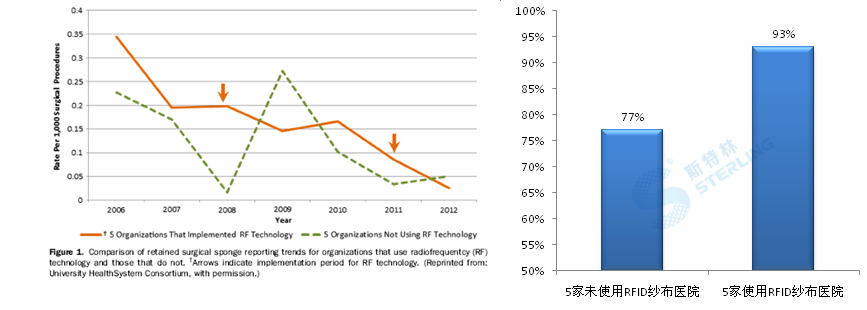
A relevant multi-center clinical study conducted in the United States between 2006 and 2012 showed that five hospitals using RFID surgical sponges (digital surgical sponges) experienced a significant reduction in the incidence of retained surgical items, with a cumulative decrease of 93%. In contrast, hospitals not using such technology exhibited fluctuating and unstable rates of retained items, highlighting the uncertainty of manual counting. Even with the introduction of complex procedures such as "surgical sponge counting racks," which required substantial additional work and prolonged surgical time, the cumulative reduction in retained surgical items reached only 77% at most.
The clinical benefits are significant.
Sterling's digital surgical sponges and monitoring system, when used in conjunction, enable automated, real-time counting and verification of surgical sponges before, during, and after procedures through computer control. This optimizes surgical workflows, reduces operative time, lowers associated surgical risks, alleviates the workload of surgical staff, and allows medical personnel to focus more effectively on the surgery itself.
In addition to automated counting, the Sterling digital surgical sponge monitor can perform non-invasive, non-contact scanning of the surgical field before wound closure. If any sponge is retained, the system immediately triggers a computer alert.
By integrating automated sponge counting and non-destructive detection via computer technology, Sterling’s digital surgical sponges and monitoring system optimize surgical efficiency, shorten procedure time, and provide dual protection against retained items.
The use of digital surgical sponges optimizes the surgical process and effectively reduces the time required for sponge counting.
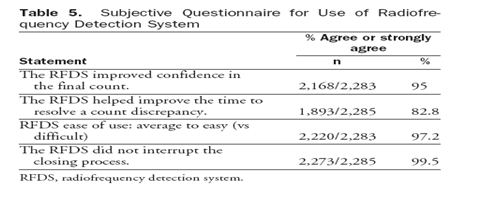
A U.S. survey conducted in 2012 involving 2,285 surgical cases indicated that 95% of users believed digital surgical sponges (RFID) enhanced counting accuracy; 82.8% of users felt they reduced sponge verification time, thereby shortening overall surgical duration; 97.2% of users found them extremely easy to use; and 99.5% of users reported that they did not interfere with surgical procedures such as wound closure and instead alleviated the workload of surgical staff.
 Another clinical study in the United States has shown that the use of RFID surgical sponges (digital surgical sponges) reduced the average operating time by 18 minutes per procedure, increased the operational efficiency of operating rooms, and significantly alleviated the workload of medical staff.
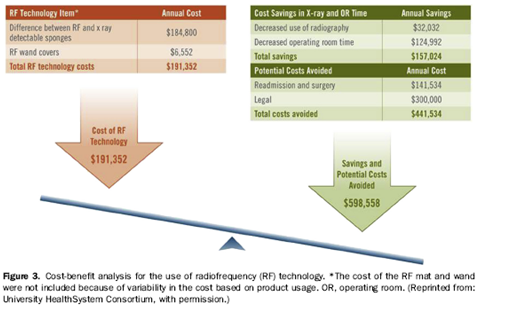
Using digital surgical sponges is more cost-effective.
A.U.S. economic study involving 11,200 surgical cases showed that the use of digital surgical sponges reduced overall costs by $407,206 by decreasing infections, repeat surgeries, X-ray examination expenses, false-negative diagnoses related to traceable X-ray sponges, and litigation. This amounted to an average reduction of $36.4 per procedure.
In developed countries in Europe and the United States, the incidence of retained surgical items is as high as 1 in 1,000 surgeries. In China, conservative estimates indicate that approximately 20,000 cases of retained surgical items occur annually.
According to a study published in the Journal of the American College of Surgeons in 2008, the incidence of retained surgical items (RSIs) in surgical procedures is approximately 1 in 5,500. In abdominal surgeries, the probability of foreign objects being left inside the body is higher, estimated at about 1 in 1,000 to 1,500. This figure is based on estimates from medical litigation, and the actual incidence rate may be even higher. Additionally, a 2013 report by American Medical News stated that an average of 40 cases of retained surgical items occur each week in the United States. These items include surgical sponges, suture needles, blades, and more. The New England Journal of Medicine has also published significant articles indicating that, among studied cases of retained foreign objects, surgical sponges account for 69%.
Retained surgical sponges can lead to life-threatening complications.
Foreign objects such as surgical sponges left inside the body often become encased by inflammatory tissue, forming tumor-like masses known as gossypiboma, textiloma, or gauzoma. This can lead to pain, refractory deep tissue infections, granulomas, fistulas, or intestinal obstruction. If not removed in time, irreversible necrosis of the affected tissues may occur, threatening the patient's life. The removal of retained sponges requires a second surgery, which not only inflicts significant physical and psychological trauma on the patient but also severely damages the reputation of medical staff and institutions, exacerbates doctor-patient conflicts, and increases the financial burden on healthcare facilities. Additionally, the surgical team involved may face related legal proceedings.
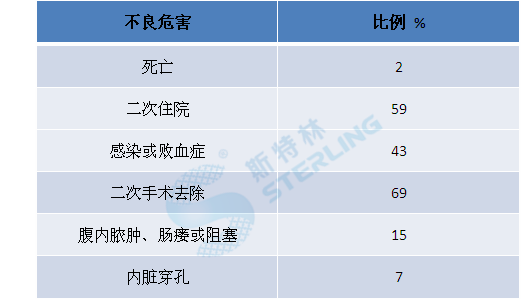 Early diagnosis of retained surgical items (RSIs) such as surgical sponges is challenging, primarily due to the lack of specific symptoms and signs associated with them. RSIs are difficult to diagnose before patients exhibit any related symptomatology. When symptoms such as pain, intestinal obstruction, or infection appear, surgical teams often tend to attribute them to other postoperative complications. As a result, diagnosed RSIs are usually identified at intermediate or advanced stages, typically after the formation of gossypibomas, severe intestinal obstruction, intestinal perforation, or even postmortem detection during autopsies. Notably, a considerable number of such cases are initially misdiagnosed as "tumors" and undergo unnecessary surgery.
The alarming cause of retained surgical items: up to 88% of cases occur even when counts are deemed correct.
The causes of retained surgical items can be primarily categorized into two major types:
Staff-related factors:
Operating room nurses often face heavy workloads, long hours, and high pressure, which can lead to fatigue and distraction. Surgeons may have varying levels of understanding and attitude toward the surgical item counting procedure. Some prioritize completing surgical steps and may overlook or underestimate the importance of the nurses' counting protocol, rushing to finish the surgery or even interrupting the counting process.
Surgery-related factors:
Emergency surgeries, complex procedures, intraoperative changes in surgical plans, or staff substitutions during surgery can result in insufficient time for thorough counting before the procedure begins, errors during the counting process, or complications due to the sudden need for additional instruments. In surgeries with significant blood loss, surgical sponges soaked in blood become difficult to identify visually. Studies have also indicated that obese patients are at a higher risk of retained foreign objects compared to others.

粤公网安备 44200002444234号